As on Feb 2026
OVERVIEW
Pakistan-Nepal relations are longstanding and based on historical, geographical, and civilizational linkages that bind the peoples of the two countries. Soon after Pakistan’s independence in 1947. Initial contacts between the two countries began in 1952 at the Colombo Plan meetings and continued at the Bandung Conference in 1955. Subsequently, Pakistan’s Foreign Minister, Hamid-ul-Haq Chaudhry, participated in the coronation ceremony of the late King Mahendra in 1956.
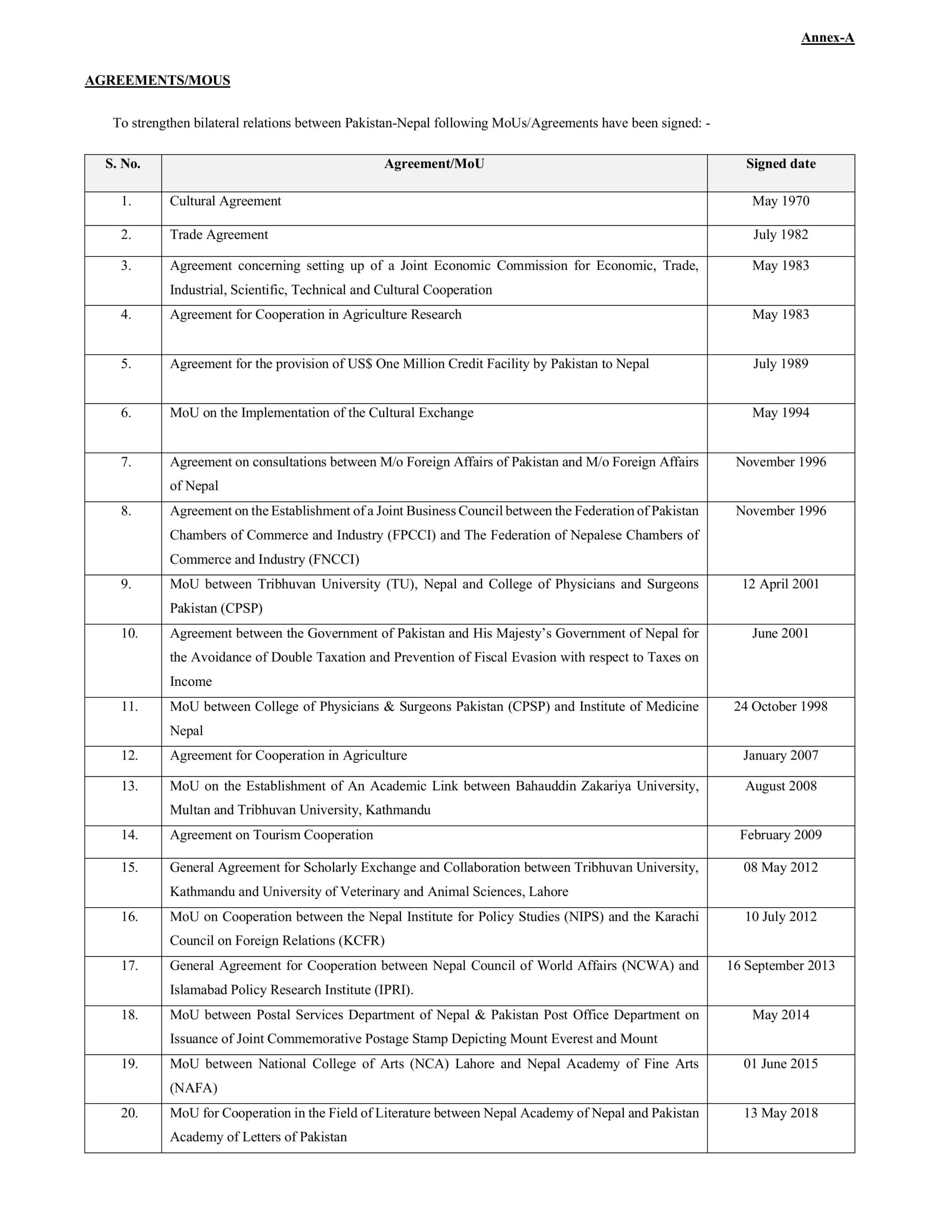
Pakistan and Nepal have maintained warm and friendly relations and have put in efforts to institutionalize the relationship by entering into agreements/MoU at “Annex-A” Both Pakistan and Nepal adhere to the recognized principles of inter-state relations, namely, mutual respect for independence and sovereignty, non-interference in the internal affairs of other countries, and abstention from the use of force, or threat of use of force, in international relations. For Pakistan, Nepal remains a strategically important country in its extended neighborhood.
HIGH-LEVEL CONTACTS
Formal diplomatic relations between the two countries were established in March 1960. In the following year, 1961, the late King Mahendra visited Pakistan, and President Ayub Khan paid a return visit to Kathmandu in 1963. During this visit, the two countries decided to establish resident missions in each other’s capitals. Since then, various high-level contacts between the two countries have taken place regularly. Both sides have maintained healthy interactions at the top leadership level bilaterally as well as on the sidelines of SAARC and multilateral meetings. The Prime Minister of Pakistan His Excellency Shahid Khaqan Abbasi visited Nepal in 2018. In September 2024, the two Prime Ministers met on the sidelines of 79th Session of the United Nations General Assembly in New York. Prime Minister of Pakistan His Excellency Mian Muhammad Shehbaz Sharif also met President of Nepal Right Honourable Ramchandra Paudel on the sidelines of the 29th UN Climate Change Conference (COP29) at Baku in November 2024.
COMMERCIAL RELATIONS
The two countries signed Trade Agreement in 1982 and Agreement for the Avoidance of Double Taxation and Prevention of Fiscal Evasion with respect to Taxes on Income in 2001. Pakistan and Nepal have maintained regular dialogue through the Nepal-Pakistan Joint Economic Commission (JEC), established at the level of Finance Ministers in 1983. The JEC deliberates on matters relating to trade and commerce, banking and finance, agriculture and livestock, energy, health, education, culture, tourism, telecommunications and ICT, and civil aviation. The sixth meeting of the JEC was held in Islamabad in August 2013.
The two countries’ business community has institutionalized interactions through Federation of Pakistan Chambers of Commerce and Industry (FPCCI) and the Confederation of Nepalese Industries (CNI), the Federation of Nepalese Chambers of Commerce and Industry (FNCCI) including Joint Business Council (JBC) established in November 1996. Additionally, CNI and FNCCI signed MOUs with Karachi, Islamabad, and Lahore Chambers of Commerce and Industry, reinforcing collaboration at the private sector level.
Bilateral trade between Pakistan and Nepal has steadily developed over the years. Pakistani investors have participated in joint ventures in Nepal, particularly in the textile, hotel, and banking sectors. Nepal’s exports to Pakistan include black tea, optical lenses, artificial body parts, medicinal plants, and cardamom, while imports from Pakistan consist of machinery and parts, spices, medicines and medical equipment, and household appliances.
EDUCATION AND HEALTH
Pakistan has long supported Nepal in education, health and establishing Higher Education Institutions Under the Pakistan Technical Assistance Programme (PTAP) and Colombo Plan, Pakistan provided around 50 scholarships annually scholarships to Nepali students in Medicine, Pharmacy, and Engineering. Currently, more than 200 Nepali students are pursuing higher studies in Pakistan. Additionally, Pakistan offers long- and short-term training programs for government officials including Defence personnel from Nepal. To date, Nepal has around 5,000 strong alumni who have studied in Pakistan.
BHARATPUR EYE HOSPITAL (BEH)
Pakistan has a proud history of collaboration with BEH contributing to its construction in 1987-88 through financial help of the BCCI Foundation of Pakistan. The recent addition of pharmacy, Ghulam Ishaq Khan Modular, OTs (04), outreach Ambulance. BEH, which began with financial support from the BCCI Foundation of Pakistan for its construction in 1987–88. Pakistan contributions to recent developments, including the addition of a pharmacy, the Ghulam Ishaq Khan modular operating theaters (4 OTs), outreach ambulance services aimed at improving eye care services. Pakistansupported the paperless digitization of BEH records, enhancing efficiency and modernization of hospital services.
CULTURE AND TOURISM
Nepal and Pakistan signed the Cultural Agreement in May 1970 to promote cultural relations and the Agreement on Tourism Cooperation in February 2009. The Nepal-Pakistan Friendship and Cultural Association is operational in Kathmandu. During 2024, over 5000 tourists from Pakistan visited Nepal. Huge bilateral potential exists in adventure and cultural tourism. Both countries share unique treasure of hosting 13 out of 14 highest peaks (above 8000 meters) in the world. While (Lumbini) is birth place of Lord Buddha, the Gandhara civilization (600 BCE – 1021 CE) boosted the Buddhism with Centre of Excellence around Taxila (Takshashila).
ONGOING PEOPLE-TO-PEOPLE CONTACTS
To further strengthen the longstanding ties between Pakistan and Nepal, following organizations are actively engaged in promoting educational, cultural, and people-to-people exchanges:
The Nepal-Pakistan Youth Council (NPYC) engages young leaders and professionals from both countries to strengthen cultural, educational, and social linkages.
The Pakistan-Nepal Alumni Network (PNAN) serves as a platform for Nepali graduates of Pakistani universities to maintain academic and professional connections.
The Pakistan-Nepal Friendship Association (PNFCA) operates in Kathmandu and other regions to promote cultural exchange, bilateral understanding, and community engagement.
The Pakistan Study Center (PSC) in Nepal focuses on research and awareness regarding Pakistan’s history, politics, culture, and bilateral relations. The Center organizes lectures, publications, and seminars to enhance academic collaboration and understanding between the two countries.
Annually, Pakistan Embassy in Nepal arranges number of activities Including following activities and projects:
a) T-20 Cricket Tournament
The Embassy annually organizes a T-20 Cricket Tournament in Nepal to promote sports diplomacy and hone young cricketers’ skills. The 11th Edition with 12-teams including 10 clubs Embassy and IME Global Bank was held 7-15 February 2026 on Embassy Ground.
b) Scholarships
The Embassy of Pakistan in Kathmandu organizes an annual Ambassador of Pakistan Scholarship Award Ceremony since 2013 to support deserving Nepali students in High and Higher Secondary School to encourage them in studies.
c) Essay Writing and Speech Competition Government Schools
The Embassy organizes the Annual Ambassador of Pakistan Essay Writing and Speech Competition for students of schools and universities across Nepal. These competitions encourage academic engagement, critical thinking, and awareness. Topics often focus on bilateral friendship, regional cooperation, emerging global issues, and cultural ties. This year 13th Essay and 9th Speech Writing competition is scheduled in May 2026.
d) Medical Camp
The Embassy regularly organizes free medical camps in collaboration with the Nepal‑Pakistan Friendship and Cultural Association (NPFCA) to provide essential healthcare services to underprivileged communities in Nepal. 21st Free Medical Camp is being organized on 28 March 2026 and another later in June 2026.
e) Park and Municipality Collaboration
The Embassy has actively supported the renovation and upgrading of public parks in Nepal as part of its community outreach including Open Air Gym at Bansbari Club (Kathmandu), Gulfatar Park (Open Gym), and Children Park (Budhanilkantha).
f) Support to Educational Institutions
Embassy donated a new computer laboratory at Gyanodaya Secondary School in Kathmandu on 29 November 2025, marking Pakistan’s continued support for education and digital learning in Nepal. Earlier, Embassy supported police academic school, and few in Dolakha and Illam Districts.
g) Mathani Irrigation Pond
Embassy financially supported to prepare Irrigation Pond and Canal which has immensely benefited the farmers of the area of Mathani Village located at Bhimeshwor Municipality Ward No. 5, Dolakha. The Water Pond Project at Mathani Village started in 2013/14 has become a lifeline for the farmers especially during extremely dry winters of Nepal. In absence of this irrigation pond the winter harvest is almost impossible
RESPECTIVE RESIDENT MISSIONS
Both countries have Resident Missions in Islamabad and Kathmandu. Pakistan’s Mission in Kathmandu is headed by His Excellency Mr. Abrar H. Hashmi, Ambassador Extraordinary and Plenipotentiary of Pakistan to the Federal Democratic Republic of Nepal. He assumed his assignment in April 2023 and is a career diplomat with extensive experience in Pakistan’s Foreign Service. His full professional profile and curriculum vitae are available on: CV Link: click here while Nepal’s Mission in Islamabad is headed by Her Excellency Ms. Rita Dhital, Ambassador of Nepal to the Islamic Republic of Pakistan. She reached Islamabad in November 2024. She is a career diplomat of Nepal’s Foreign Service. Her official profile and curriculum vitae can be accessed on the Embassy of Nepal (Islamabad) website: CV Link: click here